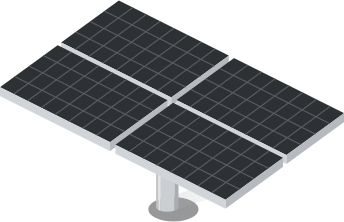
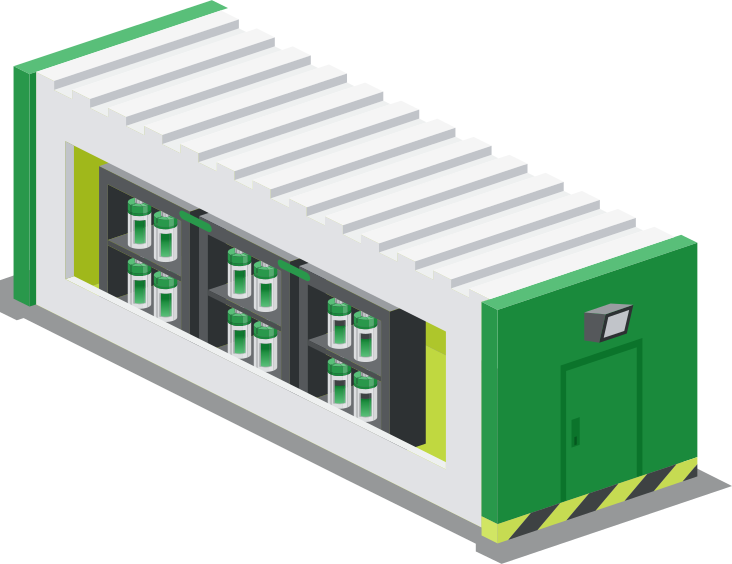
Photovoltaics produce electricity. BESS makes a business out of it. Augmenting PV with battery storage maximizes the return on every kWh and transforms a passive power plant into an active source of revenue. Retrofitting is the path from savings to profit.
A few years ago, photovoltaics were the obvious choice: an investment that saves money on electricity and reduces dependence on the grid. Simple, efficient, cost-effective. Today, that equation no longer works.
The distribution network is oversaturated at noon with energy from thousands of installations, which brings the purchase prices down to a minimum. While your PV plant is producing at its maximum, your production or warehouses have a fixed demand that only uses a fraction of the production. Without batteries these valuable surpluses flow unchecked into the grid - economically speaking: you sell a product below cost that you buy back a few hours later for a multiple.
Once the sun goes down, passive PV ends. You have to cover all the evening consumption and morning production surges with expensive purchases. This leaves your solar potential half untapped, because without storage you can only "make or not make".
BESS is changing the rules of the game. You are no longer just a passive recipient of the weather, but an active player in the market:
You know that...
New legislation (Lex RES III) puts more responsibility on resource owners. From July 2025, each PV plant must have a deviation liability agreement with a trader. The BESS itself does not replace this legislative framework, but significantly increases control over generation and consumption. The ability to cover deviations and manage surpluses makes PV operation more stable and predictable for the trader and the company itself. Stable and predictable performance means greater operational certainty and professional management of the energy portfolio.
Many companies are postponing the expansion of PV due to concerns about technical difficulties or the need to shut down production. But the reality is different. Retrofitting - the additional integration of BESS into an existing system - is done without having to shut down your machines for days.
The process starts with a state-of-the-art audit. The installation time depends on the size of the system. The actual "interconnection" with the main switchboard is a matter of a short, pre-planned process break of a few hours, which can be directed to the least busy time. Once the hardware is in place, it connects to the EMS and it immediately starts to optimize the energy flows between PV, battery, consumption and grid.
Crucially, BESS can be integrated into existing infrastructure without the need for major construction interventions. The connection method is always designed individually according to the technical conditions of the site. Your PV plant can continue to operate without restrictions. The battery storage system is thus an intelligent extension of the system that uses the existing infrastructure and adapts to the specific needs of the plant.
Owners of existing PV plants hold a huge trump card: existing infrastructure. While implementing a new greenfield energy source today means months of paperwork and uncertainty, BESS retrofitting builds on the foundations you already have. For your company, this means faster start-up and lower investment costs (CAPEX).
Do you have PV? Make the most of its potential. We offer you an energy solution that transforms savings into active income.
To provide you with the best experience, we use technologies such as cookies to store and/or access device information. Consenting to these technologies allows us to process data such as browsing behavior or unique identification numbers on this site. Failure to consent or withdrawal of consent may adversely affect certain functions and features.