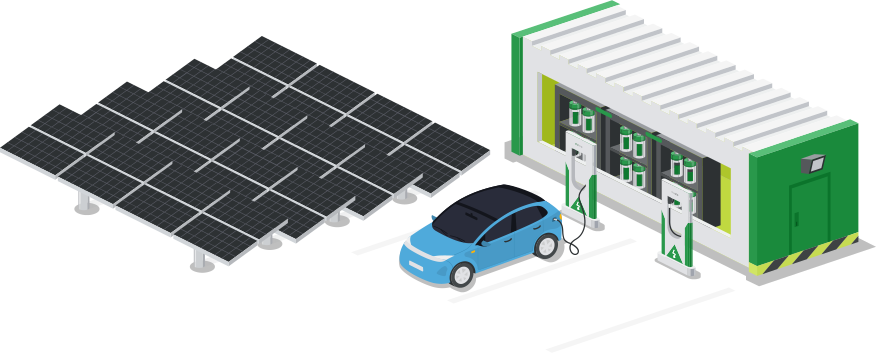
The installation of fast charging stations (HPC) on company premises often runs up against the limits of the network. BESS with intelligent control is here in the role of "virtual capacity increase". This allows you to install ultra-fast chargers immediately, without waiting for a distributor and with immediate savings on the reserved power.
Do you want to build an EV infrastructure with fast chargers on your company premises? While you're swapping your company fleet for EVs, you're running into problems with building charging infrastructure. Companies most often address in this respect that:
Battery storage eliminates these problems. BESS supports your EV infrastructure so that you always have enough power for fast-charging your EVs. By successive charging from the grid or PV, the battery is ready to deliver high instantaneous power for several DC fast chargers simultaneously. The network alone could not handle such power, not to mention the reserved capacity and peak charges.
When considering EV infrastructure, the difference between the complexity of building a new connection vs. installing a BESS is crucial. However, upfront investment is not the only benefit. BESS involvement brings benefits that define the efficiency of the entire operation.
You ensure fast charging and at the same time a stable discharge. This prevents penalties for exceeding the reserved power, which is a direct cash-flow protection.
The basic operation of stations and critical processes is insured even in the event of a network failure, reducing the risk of downtime.
Charging the own energy from the PV stored in the BESS significantly improves the efficiency of the fast chargers.
You know that...
If your company already operates photovoltaics, BESS can also be integrated retrospectively. This process, known as retrofitting (extension of the existing PV plant with a battery), allowing you to maximize your own consumption and use the solar surplus just for the dynamic needs of EV infrastructure, without having to change the original technology.
Many companies still see the battery as a passive container for electricity. For example, an analysis BloombergNEF however, points to a fundamental shift: in modern energy It's not just about how much energy you produce or store, but how efficiently you can manipulate it in real time.
The battery is hardware, but EMS (Energy Management System) is the brain that evaluates in real time when it is advantageous to store energy and when to use it, for example, to charge the company fleet, in order to keep the cost per kilometre as low as possible. Thus, the battery is not just a passive storage, but an active element that "drives demand" for your company.
Even if fast charging is your priority today, the needs of your factory change over time. This is where ENPOSOL system programmability.
The value of investing in a BESS for EV infrastructure is not just in the purchase price, but in the long-term ability of the system to respond to market changes.
To provide you with the best experience, we use technologies such as cookies to store and/or access device information. Consenting to these technologies allows us to process data such as browsing behavior or unique identification numbers on this site. Failure to consent or withdrawal of consent may adversely affect certain functions and features.